


The Practice of Paying Attention

Most days we move quickly through the world. We pass trees without noticing their shape, walk across stone without considering how it came to rest beneath our feet, and move from one task to the next without fully arriving in the moment we are living. Life becomes something we move through rather than something we experience.
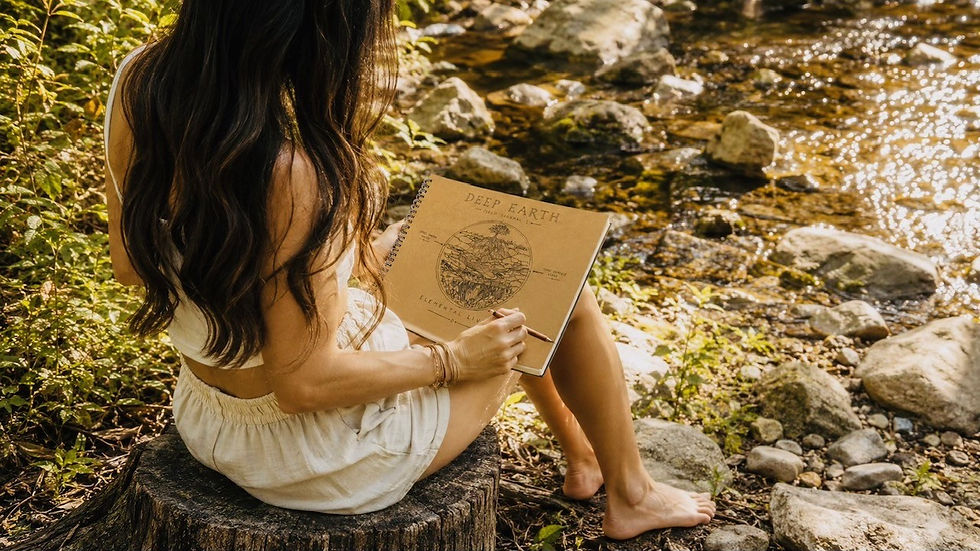
Lately, much of my time has been spent studying rocks, creek beds, roots, and textures as part of my Deep Earth field journals. What began as research for artwork has slowly become something else entirely. The longer I spend observing the natural world, the more I realize that nature is constantly offering lessons to those willing to pay attention.
A creek bed, for example, is never just a creek bed. It is a record of movement. Every curve, every worn stone, every layer of sediment tells a story about water finding its way through resistance. The roots of a tree reveal themselves only in fragments, yet beneath the surface they form vast networks that support an entire living system. Rock layers carry evidence of pressure, collapse, upheaval, and time. What appears permanent is often the result of countless changes occurring so gradually that no one moment could ever explain the whole.
The more closely I study these things, the more I notice similar patterns in my own life. Growth often happens beneath the surface long before it becomes visible. The most important changes are rarely dramatic. They arrive quietly through small choices, repeated practices, shifting perspectives, and moments of awareness that seem insignificant until years later when we look back and see how much has changed.
The practice of paying attention has also taught me something about observation itself. When we truly observe, we create a small space between ourselves and what we are experiencing. Instead of becoming every thought, we notice the thought. Instead of being swept away by every emotion, we become aware of the emotion moving through us. There is a steadiness that emerges from this way of seeing.
Nature demonstrates this constantly. A mountain experiences storms without becoming the storm. Seasons arrive and depart. Wind moves across its surface. Rain falls. Snow gathers and melts. Yet the mountain remains. There is something deeply reassuring in that image. We often spend our lives identifying with every passing weather pattern of the mind, every fear, every frustration, every uncertainty. Observation reminds us that there is something deeper beneath all of that. Like the mountain, we can learn to remain grounded while life continues to move around us.
This is one reason I believe slowing down is a creative practice. Creativity does not begin when we make something. It begins when we notice something. Before every drawing, every sculpture, every photograph, every piece of writing, there is a moment of attention. There is curiosity. There is a willingness to linger long enough for the ordinary to reveal itself as extraordinary.
Perhaps this is why keeping field journals has become such an important part of my work. They remind me to pause. To look longer. To notice the details that would otherwise be missed. A pattern in stone. The texture of bark. The path of water through a creek bed. The way morning light settles across a landscape.
The earth is always speaking in this way. Not loudly. Not urgently. But patiently. It teaches through observation rather than instruction, through presence rather than force. The question is not whether there is something to learn. The question is whether we are paying enough attention to hear it.
Warmly,
Haley Crabb
Elemental Living


Comments